Pennsylvania Research Is Community-Based, Not Name-Based
Pennsylvania genealogy records are community-based, not name-based. Identify your ancestor's ethnic and religious community to find the records others miss.

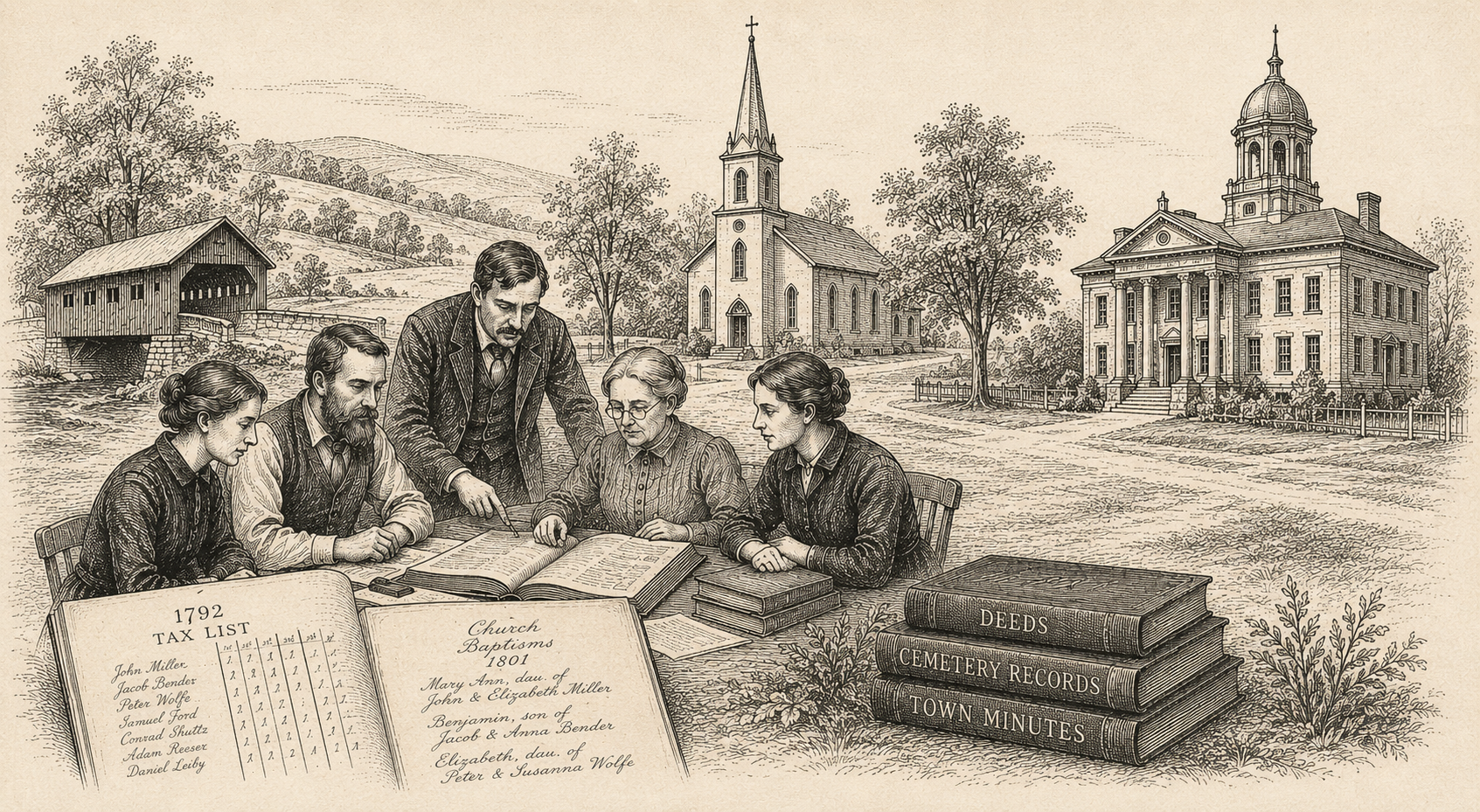
Most people research a Pennsylvania ancestor the way they research anyone else: they type a name into a search box and wait for the records to appear. For Pennsylvania, that method fails more often than it works — and not because the records are missing. It fails because Pennsylvania records were never organized around names in the first place. They were organized around communities.
This is the single most important thing to understand about colonial and early Pennsylvania research. Your ancestor's ethnic and religious background determined which records were created about them, who kept those records, and where those records sit today. Find the community, and you find the records. Search the name alone, and you search the one index Pennsylvania is least likely to have.
This page explains the community-based framework — why Pennsylvania works this way, how to identify your ancestor's community, and which record sets each community produced. It is the organizing principle behind Colonial Pennsylvania Genealogy Research: Communities and Revolutionary Era Records, 1681–1790, and it is the method this entire site is built on.
Why Pennsylvania Is Different
Pennsylvania was founded in 1681 as a deliberate experiment in religious toleration. William Penn opened the colony to anyone who would come, and they came — English Quakers, German Lutherans and Reformed, Mennonites, Amish, Moravians, Schwenkfelders, Scots-Irish Presbyterians, Welsh, French Huguenots, Swedish Lutherans, Jewish settlers, and enslaved and free Africans. By the Revolution, Pennsylvania was the most ethnically and religiously diverse of the thirteen colonies. No single group dominated, and no central authority forced everyone into one system of record-keeping.
That diversity is exactly why name-based research breaks down. In a colony with one established church and one civil registry, you can search by name because one institution recorded everyone. Pennsylvania had no established church and no statewide vital registration until 1906. Instead, each community kept its own records, in its own institutions, in its own language, according to its own customs. A German Lutheran child's birth was recorded in a church book in German script. A Quaker child's birth was recorded in the meeting's minutes. An enslaved person's existence might be recorded only in a tax list, a will, or a manumission record. These records were never merged into a single name index, because the institutions that created them never merged.
So the question that unlocks Pennsylvania research is not "where is the name index?" It is "what community did my ancestor belong to?" Once you can answer that, the records have an address.
The Core Principle: Find the Community First
Community-based research inverts the usual order of operations. Instead of starting with a name and hunting for any record that matches, you start by identifying the community, and let the community tell you which records to expect and where they live.
Identifying the community comes down to two questions:
What was your ancestor's ethnic background? German, Scots-Irish, English, Welsh, Swedish, African, and other groups settled in distinct regions, arrived through distinct ports and migration routes, and left distinct documentary trails. Surnames, naming patterns, settlement location, and language of the surviving records are all clues.
What was their religious affiliation? This is often the more powerful of the two, because in colonial Pennsylvania the church — not the county — was the primary keeper of birth, marriage, and death records. A German surname tells you to look at German-language records; knowing whether the family was Lutheran, Reformed, Mennonite, or Moravian tells you which congregation's books to open.
Ethnic background and religious affiliation together point you to a specific set of record-keeping institutions. That set is your research plan. Everything that follows — which archive, which published series, which language, which repository — flows from getting these two answers right.
The Major Communities and Their Records
Each of Pennsylvania's major communities produced a characteristic record trail. These are the principal ones. (The book treats each in depth, along with smaller communities, regional variations, and the African American records that demand their own dedicated strategies.)
The German Community
German-speaking settlers — Lutheran, German Reformed, and the sectarian groups — made up roughly a third of Pennsylvania's population by 1776. Their records are concentrated in church books (Kirchenbücher), which recorded baptisms, marriages, burials, and confirmations, often in German script. Look also to immigration lists (the Pennsylvania German pioneers ship lists), naturalization records, and church archives held by Lutheran and Reformed bodies. The single most important fact about German research: the church book usually substitutes for the birth, marriage, and death certificate that does not exist.
The Scots-Irish Community
Scots-Irish Presbyterians pushed into the frontier counties beginning around 1717 and became the dominant culture of central and western Pennsylvania. Their records run through Presbyterian session records and minutes, church records, and land warrants — this was a land-hungry, westward-moving population, and the proprietary land system (warrant, survey, patent) often documents them more thoroughly than any church book. Historical societies and county courthouse records round out the trail.
The Quaker Community
The Quakers founded the colony and kept some of the most thorough records in early America. Friends meeting records document births, marriages, and removals (the certificates members carried when transferring between meetings) with remarkable completeness. Look to monthly meeting minutes, meeting house records, and Quaker historical society and archive collections. Because Quakers recorded removals, their records can trace a family's migration across meetings and across colonies in a way few other sources allow.
The African American Community
Records of enslaved and free Africans in Pennsylvania require their own framework, because the people themselves were so often recorded only at the margins of someone else's document. The sources include census schedules, state archives holdings, manumission records (especially after Pennsylvania's 1780 Gradual Abolition Act), church attendance and membership records, and county court records. Research here is community-based in the deepest sense — reconstructing the institutions, congregations, and networks that recorded a population the standard registries were designed to overlook.
How to Use This Framework
Put the principle to work in this order:
- Identify the community before you search for the record. Use surname, settlement location, language, and religious affiliation to place your ancestor in one of Pennsylvania's communities. This is the step most researchers skip, and skipping it is why their searches stall.
- Let the community name the record set. Once you know the community, you know whether to open a church book, a meeting minute, a land warrant, or a manumission record — before you ever touch an index.
- Go to the institution that kept the record, not the name index that probably doesn't exist. Community records live in church archives, denominational repositories, the Pennsylvania State Archives, county courthouses, and historical societies — not in a single searchable database.
- Read the records in their own context. A German church book follows German conventions. A Quaker minute follows Quaker ones. The community that created the record also tells you how to read it.
The payoff is that brick walls built by name-based searching often come down the moment you switch to community-based searching. The ancestor you "can't find" is usually sitting in a record set you weren't looking at — because you were searching for a name in a colony that filed everyone by community.
Start Here
For the complete treatment — every major and minor community, the full record set each one produced, regional research strategies, and step-by-step guidance for putting the community-based method to work, including AI-assisted techniques for reading and organizing these records — see Colonial Pennsylvania Genealogy Research: Communities and Revolutionary Era Records, 1681–1790 by Denyse Allen, available on Amazon. The book is built entirely on this framework, with dedicated chapters for each Pennsylvania community.
The communities are the key. Find the community, and you can track your ancestor among their people and back to their ancestral home.
Frequently Asked Questions
What does "community-based, not name-based" mean in Pennsylvania research?
It means that Pennsylvania records were organized around ethnic and religious communities rather than around individual names. Because Pennsylvania had no established church and no statewide vital registration before 1906, each community kept its own records in its own institutions. To find an ancestor, you first identify their community — their ethnic background and religious affiliation — and that tells you which records were created and where they are held. Searching a name alone usually fails because the single name index you're hoping for often doesn't exist.
Why doesn't name-based searching work well for colonial Pennsylvania?
Name-based searching assumes one institution recorded everyone in one place. Colonial Pennsylvania had the opposite: dozens of religious and ethnic communities, each keeping separate records, in separate repositories, sometimes in German or Latin. There was no central civil registry to merge them. So a name search only works if someone has already indexed the specific community record your ancestor appears in — and for the colonial period, that's frequently not the case.
How do I identify my Pennsylvania ancestor's community?
Use two questions. First, what was their ethnic background — German, Scots-Irish, English, Welsh, Swedish, African, or another group? Clues include surname, naming patterns, settlement location, and the language of nearby records. Second, what was their religious affiliation — Lutheran, Reformed, Mennonite, Moravian, Quaker, Presbyterian, or another? Religion matters most, because in colonial Pennsylvania the church was usually the primary keeper of birth, marriage, and death records. Together these two answers point you to a specific set of record-keeping institutions.
Where are Pennsylvania community records kept?
They are spread across the institutions that created them: church archives and denominational repositories (Lutheran, Reformed, Presbyterian, and Quaker bodies), the Pennsylvania State Archives in Harrisburg, individual county courthouses, and local and regional historical societies. There is no single database that holds them all, which is exactly why identifying the community first matters — it tells you which repository to approach.
Does the community-based framework work after the colonial period?
Yes. The framework is strongest for the colonial and Revolutionary period (1681–1790), when community institutions did almost all the record-keeping. As civil record-keeping expanded in the 19th century and statewide vital registration began in 1906, name-based indexes became more useful. But community context still explains where records were created and survives as the fastest way through pre-1906 brick walls.
© 2019–2026 PA Ancestors L.L.C. and Denyse Allen. All Rights Reserved.
About PA Ancestors: The authoritative resource for Pennsylvania genealogy research — vital records, county courthouses, archives, probate, land records, military records, and immigration research across all 67 Pennsylvania counties. Founded by Denyse Allen, Pennsylvania genealogy researcher and author.
More Pennsylvania Research: paancestors.com