The Importance of Death Certificates for Genealogical Research
Discover how death certificates play a vital role in genealogical research. Learn about the history, purpose, and process of obtaining death certificates in Pennsylvania for your family tree.


Pennsylvania death certificates are one of the most information-rich documents available for genealogy research. The state began issuing them in 1906 through the Department of Health, and every person who died within Pennsylvania's borders received one — even unidentified individuals. Death certificates older than 50 years are public record and available to anyone.
If you're researching Pennsylvania ancestors, a death certificate is often the best starting point. It gives you the deceased's full name, birth date and place, parents' names (including mother's maiden name), occupation, cause of death, and burial information — all on a single document. Here's what you need to know to find and use them.
The Evolution of Death Certificates
Throughout most of human history, death records primarily focused on burial details. Burial registers maintained by clergy and gravestones marking final resting places were the main sources of information about the deceased.
However, as the industrial age began in England, tracking the causes of death became essential. European governments, followed by the United States, sought to monitor and understand the factors contributing to their citizens' deaths. In 1837, Britain became the first country to implement civil recording of deaths, marking a significant milestone in the history of death certificates.
In Pennsylvania, the Department of Health (DOH) was established in 1905, leading to the introduction of death certificates in 1906. These state-issued certificates aimed to standardize the recording of deaths and were made mandatory for every individual who died within the state's borders, even if the person was unidentified. However, it took time for full compliance with the new system, particularly in rural areas and among economically disadvantaged communities.
The Purpose of Death Certificates
Death certificates serve multiple purposes for both the government and families. From a governmental perspective, death certificates are crucial for vital statistics, public health monitoring, disease awareness, and population counting.
For families, death certificates initiate the distribution of the deceased's estate, insurance claims, and death benefits. While death certificates are invaluable for genealogical research, it's important to note that they were not initially intended for this purpose.
In addition to these purposes, death certificates are also required for burial or cremation. Funeral homes and cemeteries rely on death certificates to fulfill their legal obligations.
Furthermore, death certificates play a vital role in probate proceedings, Social Security Death Benefits, life insurance claims, and employer pension packages. In cases where a death is considered suspicious or unnatural, death certificates issued by coroners or medical examiners indicate that an investigation was conducted.
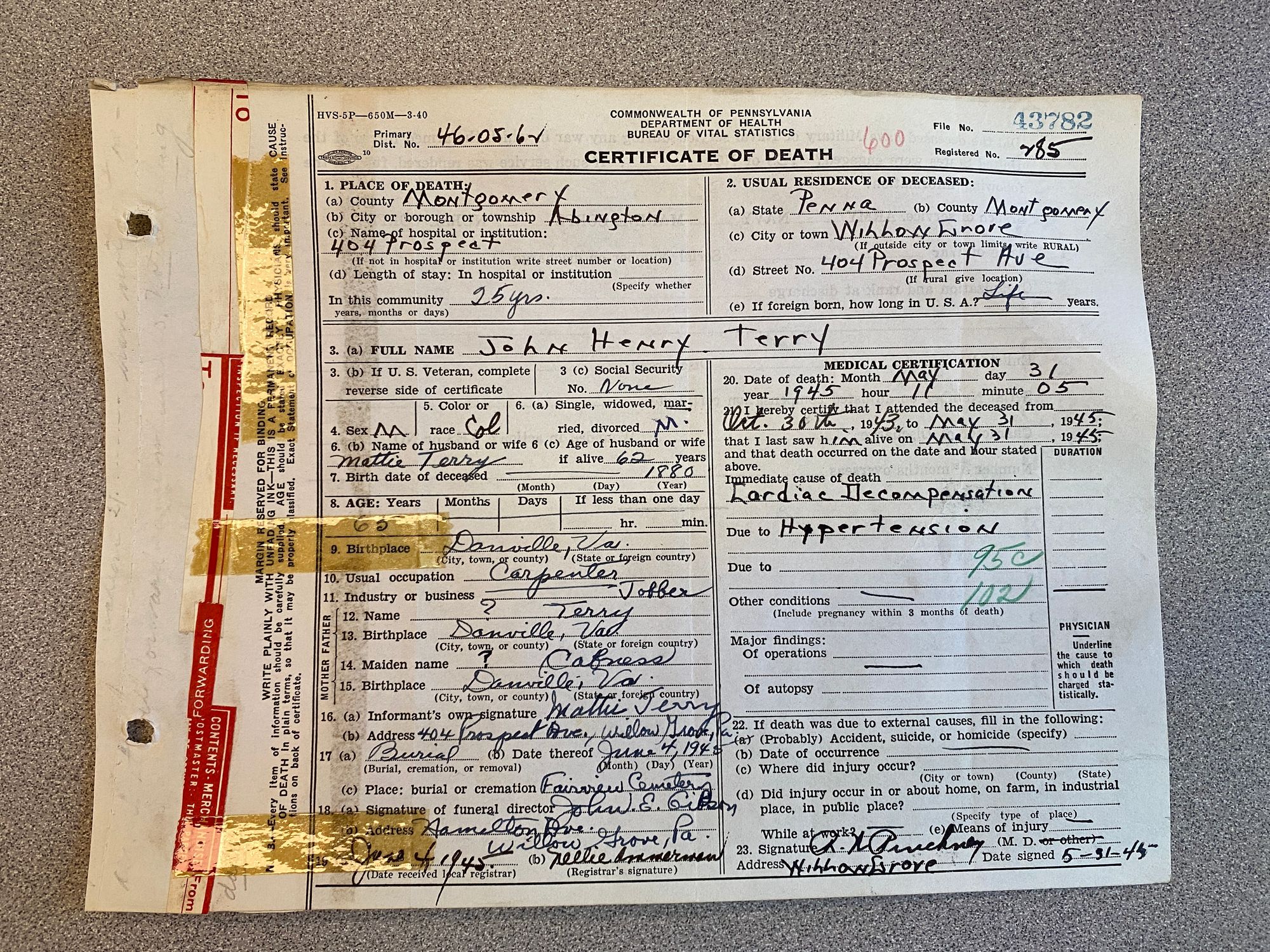
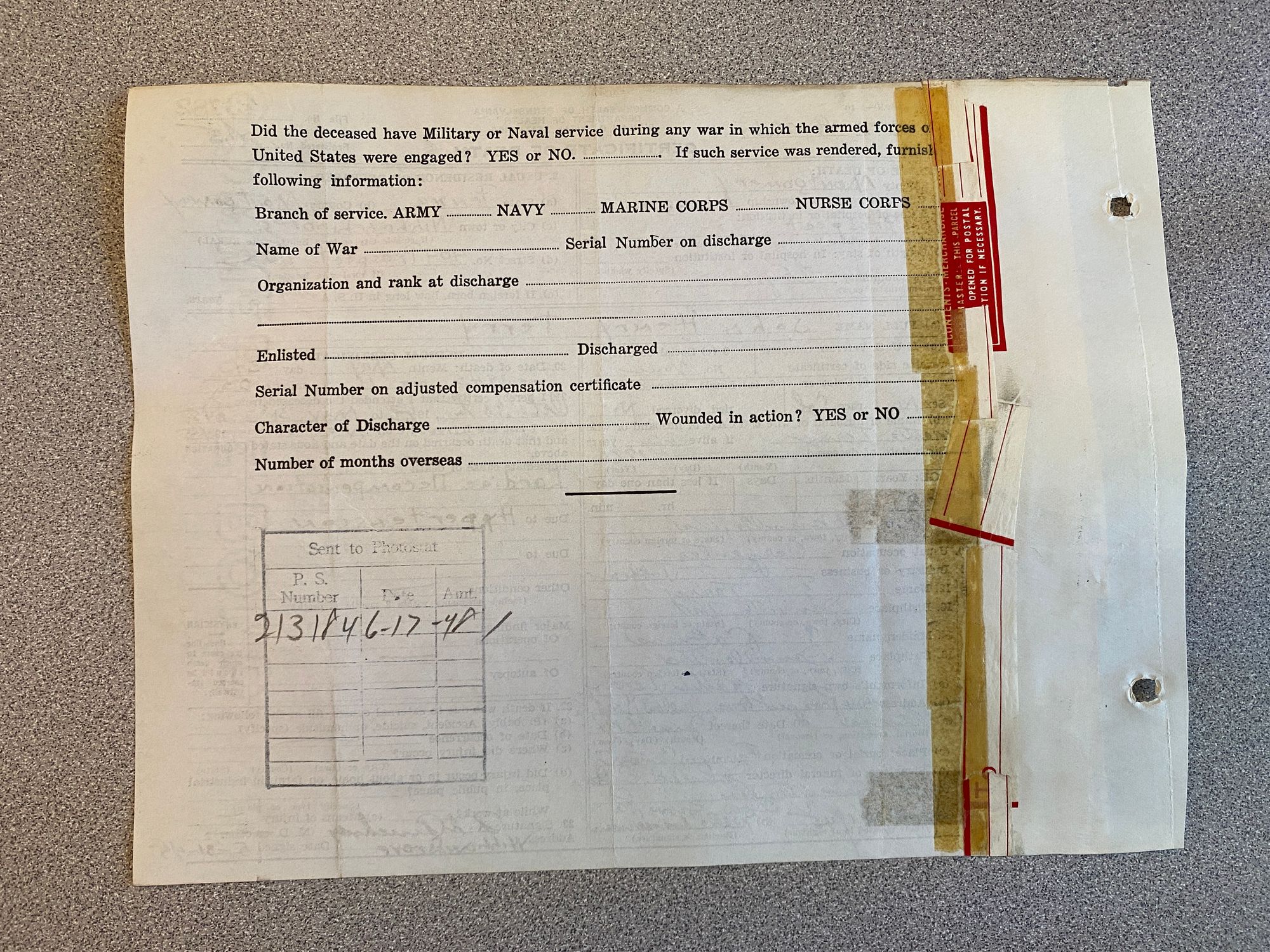
Information Collected on Death Certificates
Over the years, the format and fields included on death certificates have evolved. The following is a list of the information typically collected on death certificates starting from 1906:
- Registration District and Area
- Place of Death (County, Township/Borough/City, Street, and Ward)
- Length of Residence in the City or Town Where Death Occurred
- If Death Occurred in a Hospital or Institution, Length of Stay
- Usual Residence of the Deceased
- If the Deceased Was Foreign-Born, How Long in the US or Citizen of What Country
- Full Name of the Deceased
- If the Deceased Was a US Veteran or in the US Armed Forces
- Social Security Number
- Sex and Race
- Date and Place of Birth
- Age at Death
- Marital Status and Spouse's Name
- Parental Information (Names, Birthplaces, and Maiden Name of Mother)
- Occupation and Industry of Work
- Date of Last Work and Total Time Spent in Occupation
- Informant Signature and Address
- Date and Time of Death
- Certification of Attending Physician or Medical Examiner
- Cause of Death and Contributory Causes
- Findings of Operation or Autopsy
- Details of External Causes (if applicable)
- Burial, Removal, or Cremation Information
- Undertaker or Funeral Home Information
- Registrar Signature and Date
It's important to note that the specific fields and format may vary slightly depending on the year.
The Significance of Death Certificate Codes
Every death certificate includes numerical or numerical/alphabetical codes in the "cause of death" section. These codes refer to the International Classification of Diseases (ICD) database, which categorizes causes of death. The ICD codes were established in France in the late 1800s and have been widely adopted worldwide. They aid in compiling vital statistics and facilitate the categorization and counting of deaths based on causes.
Researchers and genealogists can refer to these codes to understand the cause of death when the handwritten text is illegible or difficult to decipher. However, it's important to use the ICD code list that corresponds to the year of the death certificate to ensure accurate interpretation. A transcribed list of historical ICD codes can be found at www.wolfbane.com/icd.

Accessing Death Certificates in Pennsylvania
Accessing death certificates in Pennsylvania depends on the date of death. Recent death certificates, issued within the last fifty years, are restricted to immediate family members. However, death certificates older than fifty-one years are considered public records and available to anyone without restrictions.
To obtain certified copies of recent death certificates, immediate family members can request them directly from the Pennsylvania Department of Health (DOH) through their website. The DOH provides information on ordering procedures, pricing, and any specific requirements.
For death certificates older than fifty-one years, the original documents are transferred from the DOH offices to the Pennsylvania State Archives. Each year, a new batch of certificates becomes publicly available. Researchers can access these original certificates at the State Archives in Harrisburg, Pennsylvania. Ancestry.com also provides digital access to Pennsylvania death certificates with ongoing efforts to digitize and index additional years.
Conclusion
Death certificates are invaluable resources for genealogical research, providing a wealth of information about our ancestors' lives and deaths. By utilizing death certificates effectively, genealogists can piece together the puzzle of their family's past and gain a deeper understanding of their roots.
Last Updated: February 2026
Related Pennsylvania Research Guides
- Pennsylvania Birth Certificates
- Marriage Licenses in Pennsylvania
- Probate Records in Pennsylvania
- Pennsylvania County Courthouses — All 67 Counties
- Essential Guide to Vital Records Research
For the complete guide to Pennsylvania death certificates across every era — including where to find pre-1906 death records, how to read ICD codes, and county-by-county research checklists — see Pennsylvania Vital Records Research by Denyse Allen.
If you've found your ancestor's death certificate and want to write their story, Chronicle Makers is a community of family historians doing exactly that — turning research discoveries into finished family stories.
Frequently Asked Questions
When did Pennsylvania start issuing death certificates?
Pennsylvania's Department of Health was established in 1905 and began issuing death certificates in 1906. Before that, death information was recorded primarily in church burial registers, cemetery records, and local government filings. Compliance was slow in rural areas, so some deaths from 1906–1910 may not have certificates.
How do I get a Pennsylvania death certificate?
For deaths within the last 50 years, only immediate family members can request certified copies from the Pennsylvania Department of Health. Death certificates older than 51 years are public records held at the Pennsylvania State Archives in Harrisburg. Many older certificates are also available digitally through Ancestry.com.
What information is on a Pennsylvania death certificate?
Pennsylvania death certificates include: full name, date and place of death, date and place of birth, age, sex, race, marital status, spouse's name, parents' names and birthplaces (including mother's maiden name), occupation, cause of death, burial or cremation details, and the funeral home used. Certificates from different decades may include additional fields like Social Security number and veteran status.
What do the codes on a death certificate mean?
The numerical codes in the "cause of death" section refer to the International Classification of Diseases (ICD) system, established in France in the late 1800s. These codes standardize cause-of-death reporting worldwide. Use the ICD code list matching your certificate's year for accurate interpretation.
What if I can't find a death certificate before 1906?
Before 1906, look for church burial records, cemetery sexton records, newspaper obituaries, county coroner records, and probate files. Some cities and counties kept their own death registers before the state system began. For a complete guide to finding these substitute records, see Pennsylvania Vital Records Research by Denyse Allen.
© 2019–2026 PA Ancestors L.L.C. and Denyse Allen. All Rights Reserved.
About PA Ancestors: The authoritative resource for Pennsylvania genealogy research — vital records, county courthouses, archives, probate, land records, military records, and immigration research across all 67 Pennsylvania counties. Founded by Denyse Allen, Pennsylvania genealogy researcher and author.
More Pennsylvania Research: paancestors.com