Live Book Walkthrough: Colonial Pennsylvania Genealogy Research
Watch the live walkthrough of Colonial Pennsylvania Genealogy Research by Denyse Allen. Learn how to find the right records for your ancestor's ethnic or religious community in colonial and Revolutionary Era Pennsylvania.

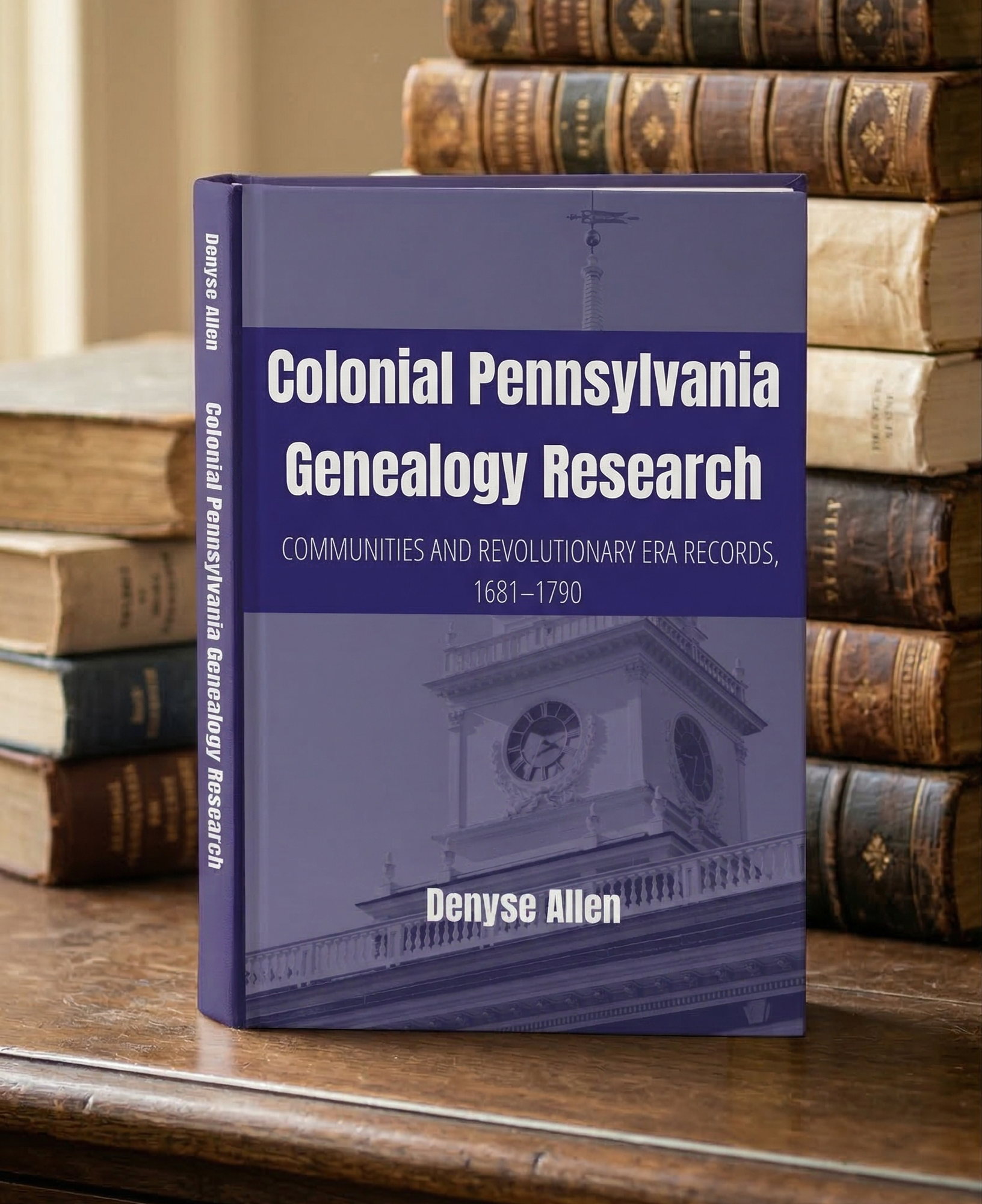
On March 20, 2025, I hosted a live walkthrough of my book Colonial Pennsylvania Genealogy Research: Communities and Revolutionary Era Records, 1681–1790 for readers and PA researchers.
In this session I cover:
How to find the right chapter for your ancestor's ethnic or religious community. How to work through record types when your first source doesn't give you what you need. The repositories most researchers don't know about — and how to contact them.
This is the recording of the full presentation (Q&A removed for privacy).
If you don't have the book yet, you can pick up a copy on Amazon.
Full Transcript
Let's get started. This is the walkthrough for Colonial Pennsylvania Genealogy Research. Thank you for buying the book.
My name is Denyse Allen. I'm a real person — this is not AI generated. I started PA Ancestors in 2019 with the intention of doing client research. I knew Pennsylvania was a confusing state for researchers, and that seemed like useful work. Then COVID happened, and we weren't going to archives for two years. A lot of them were saying, "Please don't come into the buildings." In that process, I started making content around Pennsylvania research to help other people.
This book was very much about getting everything off my hard drive. This book and my next book are about clearing off all the information I've collected about how to research in Pennsylvania — all the people that were here — and getting it published so it's useful to everybody. I really want it to be useful. And I think even though we have AI and the internet, a book is still the most useful form for content. Some things never change.
What We'll Cover Today
We'll go through what's in the book and how to use it — because it is a big book. I'll cover why it's structured the way it's structured, how it's organized, the system I used for placing the records, and why one source leading to three more is okay. That's the process.
This book was published this year because of the 250th. I set Pennsylvania Ancestors aside last year and focused on AI for research and writing in general. But I kept thinking about the 250th, kept thinking about my Pennsylvania ancestors, and I realized I really needed to get this all off my computer and share it.
The book shocked me at 404 pages — which amused me, because a 404 is the error you get when you hit an internet page that doesn't exist. I feel like a lot of people feel that way about Pennsylvania research. They hit a 404 and their people don't exist.
The Book's Structure
There are 29 chapters. Twenty of them focus on the communities of Pennsylvania — basically who your ancestors hung out with. I spent a lot of time on the published Pennsylvania Archives book series (not the Pennsylvania Archives building). And I covered the roles people played in the Revolutionary War.
The book originally was going to be called Revolutionary War Era Research. Then I realized it really covers the whole colonial period, because you can't understand who was in the Revolutionary War unless you understand where they came from — from 1682 or earlier onward.
The book has four parts:
Part One: Foundational Context. What makes Pennsylvania unique. We developed rapidly as a colony and state, and in that rapid development there's a lot of confusion for people researching backwards in time. County lines are constantly changing. Municipal lines within the counties are constantly changing.
Part Two: Community Chapters. This is the bulk of the book. These chapters are organized by religious and ethnic groups, and also by roles — indentured servants are in there as a specific role because that crosses several ethnicities. I organized it this way because if you're doing cluster research, this is a great way to figure it out.
The other thing to be aware of — this isn't how we live now, but it's how people lived then — you didn't marry outside of your faith. The Quakers are the obvious example. They left a great paper trail of who they kicked out for marrying outside the faith. But that was the case for almost every faith. If you think about your ancestors that way, you can rule in or rule out a lot of potential candidates in your research by clustering them in these communities.
Part Three: Revolutionary Era War Roles. A lot changed in people's lives after the Revolution. There was loss of life, brother against brother, family against family. A lot of people were just trying to stay neutral. Some of that was their religion — we had faiths beyond the Quakers who were conscientious objectors. The Brethren fell into that category. The Schwenkfelders fell into that category. They paid fines, they were jailed, they were run out of the state.
I also reference the First Great Awakening in this book, which was a major religious revival movement that caused people to shift religions or caused their churches to break apart into different factions. There's a Second Great Awakening after the Revolutionary War that I'll cover in detail in my next book, because that's when a lot of people lose their ancestors while tracing them back through religious records.
Part Four: Research Advice. These are the typical record types — probate records, land records, and so on. Where you find them. A directory of the major repositories.
What Makes Pennsylvania Different (and Weird)
Other than the fact that we don't have straight lines for land boundaries — I know everyone from the Midwest asks, "Could Pennsylvania please have straight lines?" No. We can't.
No colonial census. This is a real drawback. We have tax lists in some counties that have survived, and only for some years. Tax lists are what you'll rely on. What's called the septennial census is really a tax list — you probably know that. It's on Ancestry.
The proprietary land system. The Penn family divided up the land, and there were actually very few landowners — many more tenants living on properties. When the Penn family divided land, they didn't survey it all first and then divide it. They divided it and then said, "Go survey that piece you were just given." So a lot of land parcels ended up overlapping with each other. When you're researching land in the colonial period, it's not a straight line like doing deed research. You have to look around and check your ownership. I didn't go into this in depth because there's an excellent in-depth book on land record research for Pennsylvania — it's a big blue book and it's very thick.
Border disputes. I grew up in Pennsylvania and never knew that Connecticut claimed the top half of the state for over 50 years. I told my parents and they said, "Really?" That was a major land dispute with a lot of bloodshed. We also had disputes with Virginia and Maryland over boundaries. If your people lived close to those borders, you'll have to research in those states too.
The Pennsylvania Archives series. These are the published books. They've all been digitized. They started publication in the 1850s and unwisely decided to throw things out after they were transcribed and put into the books. So a large portion of the Revolutionary era and colonial material doesn't exist in its original form anymore. We consider these published volumes to be the original sources at this point.
That said, the Pennsylvania State Archives building in Harrisburg does have additional colonial and Revolutionary era records — ledger books for paying out soldier uniforms, food distribution records, accounting books. Those have been digitized and put on the Power Library for the state, and they're working on getting them transcribed and more accessible. As soon as that happens, it's going to open up a lot of findings for colonial and Revolutionary ancestors.
Records are still spread out everywhere. Neighboring states have centralized. New Jersey has all the county records at the state archive. Maryland has all the county records at the state archive. Delaware is just Delaware — it's small, so everything's in one archive. But in Pennsylvania, the county records are still in the counties. If you're doing deep research, you'll need to go to the county courthouse or contact them. A lot is on FamilySearch, but not everything.
County evolution. Cumberland County at the time of the Revolution was 3,000 square miles. If you have an ancestor in Cumberland County, that could be a lot of places by 1800. You have to constantly recalibrate — where am I as I go through this record?
The Community Chapters
I recommend that your main research strategy is to find your community and start in that chapter. I did not intend for people to read all the community chapters. If you do, they're incredibly boring in sequence because they're all formatted the same way. I'm sorry — it needed consistency.
The Quakers have a good overview. There's a lot of in-depth Quaker research available in webinars and presentations because they left so many records. Same with the Germans. The Scots-Irish did not leave a lot of records, but I give you tips in their chapter to help with researching them. If you're not sure of the community, you can start ruling in and ruling out based on what you're learning in each chapter.
These are your people — the people your ancestors knew and associated with.
The communities are listed in the book roughly in the order they appeared in the colony. So if you're not very far back, you might start with the Methodists. And I'm sorry — those records are hard to find and they're not great. They get better after the Civil War, but that doesn't help us for this period.
Some communities are identified by religion, some by ethnicity, and in the ethnic chapters there are several different religions they might be. The Welsh are one of those — they might be Baptist, Anglican, or Quaker.
What's in Each Community Chapter
Each community chapter follows a four-part structure:
- Historical context — who these people were, where they came from, why they came to Pennsylvania. You could read a whole book on any single community. This is meant to be an overview and an awareness exercise of who was here. If you find your people, please do more in-depth research.
- Where the records are held — I do not provide a lot of URL links. I'm going to be opinionated here: without the historical context, you don't understand what you're looking at. I could have provided a bunch of links, but I pointed to the specific kinds of records and the repository where they're held. You're not beginner researchers — if you're buying this book, you're a more advanced researcher. You know to go to that repository's website and look for that specific set of records. And in a paperback book, URL links are useless.
- The specific kinds of records they created — especially if they were unique to that community. I wanted you to know the name of the record, how it was used, and how it was completed.
- Conventions, languages, recordkeeping practices, and how to interpret them — there are people who are more advanced on some of these communities than I am. I gave you the grounding and tried not to go over my skis.
The Record Types
The record type chapters are at the end of the book. This is the standard material — probate records (which we call estate files in Pennsylvania; if you walk into a courthouse, that's what they call them), land records, and the rest. It defines them, explains what they are, when the record is created, and what caused it to be created.
In my next book — covering 1790 to 1910 — I'll take you over the hump to when vital records get created reliably in 1906. There are a lot of changes to probate laws, vital records laws, and property laws in that period. Married women owning land, single women owning land — I'll make sure all of that is covered.
The repository directory covers the major repositories. I did not include an entire courthouse listing — I trust you can look that up. But I describe the repositories and how they work.
And I will make a plug: if you have not visited the Pennsylvania State Archives in their new building, I highly recommend it. If you're traveling a distance, it's worth a couple of days. It's set up for researchers, not just record storage. There's space to spread out. They have a lunch area where you can bring your lunch and stick it in the refrigerator and eat looking out on the Susquehanna River. The manuscript collection has its own room where you can really spread out and access things. The staff is incredibly knowledgeable, more than willing to help, and they love genealogy researchers. Most of our courthouses love seeing genealogy researchers too. One exception might be Philadelphia, but that's Philadelphia. I personally haven't had a problem with them.
Research Strategy
This five-step approach is probably basic for most of you, but here it is:
- Start with what you know. Have it written down, clear, and confirmed — what's absolutely true to the best you can prove.
- Identify your community. You might need to do process of elimination. If it's a German surname, you're not going to the Scots-Irish section or the Welsh section. You're probably not doing the Catholic section because the German Catholics come later. You may need to check a few chapters to figure out specifically what kind of German speaker or surname you have.
- Work through the record types using the last two chapters.
- Follow the leads — when one source leads to three more, that's the process working.
- Go deeper with the community-specific resources.
The Revolutionary Era Chapters
If you've watched the Ken Burns series on the Revolutionary War — it's great. I'm learning a ton about how British soldiers behaved while they were deployed here. I didn't realize the extent of sexual assaults against women. That might explain some DNA surprises for those of us who can trace back that far. I didn't cover that in the book because I just learned it from the Ken Burns series, but it's something for version two.
As you probably know, we had our Patriots, but the largest group was the unaffiliated — people who were really trying to stay out of it. Our Patriots are what we're researching especially this year, trying to get their stories straight. I hope I've provided more resources for you beyond the lineage society application.
If you're like me, you're descended from a patriot and you looked at the SAR or DAR application but never really did the deeper research. I realized I didn't understand what my soldier went through — what battles he was in, what his life was like. That's another reason I wrote this book.
The Loyalist chapter covers the records Pennsylvania produced around the people we kicked out or whose estates we confiscated.
And the Privateers — people don't think about Pennsylvania being a coastal state, but Philadelphia is a major port off the Delaware River. We had Spanish pirates, French ships. Most of the hard currency in the colonial period was Spanish, not English. We had state-issued privateering as well as federal, where ships could go out and confiscate what was on British vessels. Some of it happened on Lake Erie, but not much — that was still considered Native American territory. The War of 1812 changes that, and I'll cover it in the next book.
The Appendices
The appendices include a short list of resources I use in addition to what's in the chapters. I spent a lot of time referencing the Sidney George Fisher books written at the end of the 19th century. I like him as a historian because he's incredibly opinionated about the different ethnic groups and their impact on the state. We don't talk about people that way anymore — we just talk about people in general. But when you're doing genealogy research, it does matter where they came from and what their religion was. Fisher also controversially wrote about the American Revolution as a civil war between two warring factions of the British. People at the time said he was wrong, but now some historians are coming around to that point of view — the Revolution as America's first civil war.
There's a glossary of colonial-era terms. As experienced researchers you probably have your own references, but I wanted to make sure anyone on the newer side had an easy reference. I also include references for reading old handwriting and a section on dating problems — the confusion between surnames changing (especially for German ancestors, where the name changes every time it's recorded), place names changing because county or municipal lines were redrawn, and the way we recorded dates changing during this period. Colonial research is not for the faint of heart.
I include a guide for the Pennsylvania Archives book series, though the best guide for it is still the book published in 1949.
What's Coming Next
I'm writing a companion piece about writing the stories of Revolutionary War ancestors — how to position the story and ground it in historical context. It's not a genealogy research guide at all. It's about the writing. It covers how to look at the war from the perspectives of free and enslaved Black people, Patriots, Loyalists, and the unaffiliated. It's about writing from the evidence — not historical fiction, but assembling what you have in the actual records and the historical research, using AI to assist with that process. It's meant to be an enhancement to the research book.
My next research book will cover 1790 to 1910, which should take you over the hump to when vital records start being created reliably in 1906.
A Small Ask
If you could leave a review on Amazon, that would be a great thing for other Pennsylvania researchers. Just scroll down to "Write a customer review," give it your honest star rating, and a sentence or two. What's the most important thing for another researcher to know about this book?
I'm not asking you to give it five stars. Be honest. But if you're going to give it four stars or less, tell me why — so that if I update this book, I know what to improve. I want this to be the most useful book on colonial Pennsylvania research that exists. That was my goal.
Thank you for being here, and thank you for buying the book.
© 2019–2026 PA Ancestors L.L.C. and Denyse Allen. All Rights Reserved.
About PA Ancestors: The authoritative resource for Pennsylvania genealogy research — vital records, county courthouses, archives, probate, land records, military records, and immigration research across all 67 Pennsylvania counties. Founded by Denyse Allen, Pennsylvania genealogy researcher and author.
More Pennsylvania Research: paancestors.com