Revolutionary War Pension Records for Pennsylvania Soldiers
Step-by-step on how to find military pension files of Pennsylvania citizens for service during the Revolutionary War.

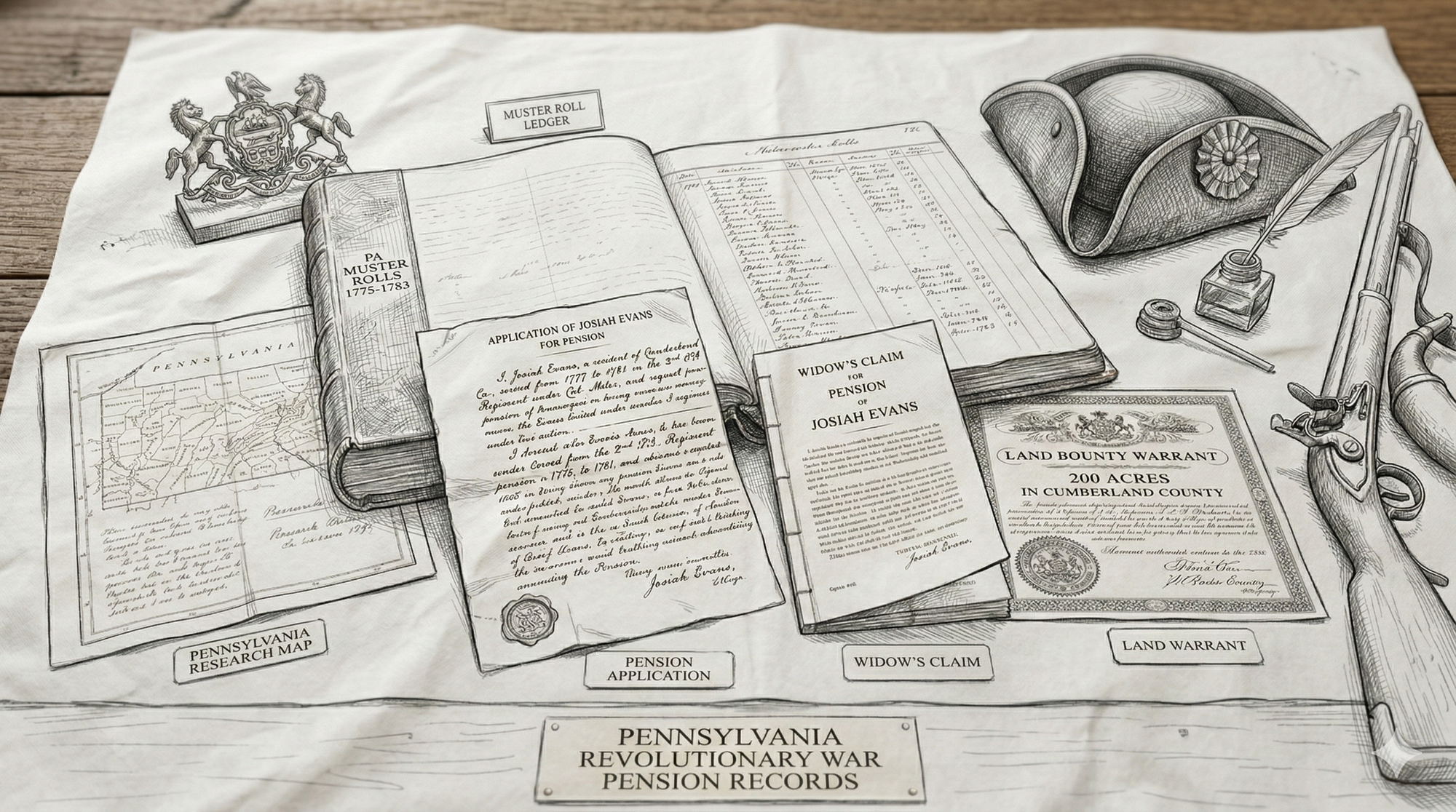
Revolutionary War pension files are among the most valuable genealogical records in existence. A single pension file can contain a veteran's age, birthplace, residence, names of fellow soldiers, marriage information, and children's names and birth dates — information rarely found anywhere else for this period. If your Pennsylvania ancestor served in the Revolution, a pension file may be the single richest document you'll ever find for them.
Congress passed multiple pension acts between the 1780s and 1850s, each with different requirements. The most important for genealogists is the Act of 1832, which provided pensions based on service alone — no need to prove poverty. This resulted in thousands of applications where veterans described their service in their own words, often decades after the war, with extensive biographical detail.
What Pension Files Contain
Veteran's Applications
When a veteran applied for a pension, he provided biographical information — full name, age or date of birth, current residence, and sometimes place of birth. He gave a service narrative describing when and where he enlisted, the officers he served under, battles and campaigns he participated in, and where he was discharged. Some files include family mentions, discharge papers, and affidavits from fellow soldiers.
Widow's Applications
When a widow applied, she needed to prove both her marriage and her husband's service. Widow's files often contain the most genealogical detail of any pension record: marriage proof (church records, family Bible pages, witness affidavits), the husband's service history, the date of marriage, children's names and birth dates, and the husband's date of death. If a veteran died before pensions were available, his widow's file may be your best source.
Depositions and Supporting Documents
Pension files often include testimony from fellow soldiers, neighbors, ministers who performed marriages, and anyone who could attest to service or family relationships. Correspondence between the veteran or widow and pension officials may also survive, sometimes adding personal details not found elsewhere.
The 1832 Applications: Why They Matter Most
The 1832 pension act required veterans to describe their service in their own words. These first-person narratives are extraordinary. A veteran might describe exact dates of enlistment and discharge, names of officers and fellow soldiers, places marched through, battles witnessed or participated in, and personal experiences.
For genealogists, 1832 applications offer precise ages and birthplaces, residence at time of application (which may be far from Pennsylvania, showing migration), family connections through witnesses who were often relatives, and detailed military service information found nowhere else.
Where to Find Pension Files
The Pension Index is the starting point. It's available free on FamilySearch and Ancestry, and identifies file numbers and the type of service claimed. Always search for both the veteran and his widow — the widow's file may contain different information.
Fold3 has the most complete digital access to the actual pension files. This is a subscription service but many libraries provide access.
NARA (National Archives) holds the original files in Record Group 15. You can order copies or visit NARA research rooms in person.
FamilySearch is digitizing some pension files and provides free access to the index.
The key microfilm series are M804 (the index to pension and bounty land warrant application files) and M805 (selected records from the files themselves).
Don't Stop at Pensions: Depreciation Pay and Soldiers' Pay
Many genealogists overlook a critical source: the Depreciation Pay and Soldiers' Pay records in Pennsylvania Archives, 5th series, volume 4, pages 107-496 and 599-777. These document soldiers who were compensated for currency depreciation during the war. They include soldiers who never received pensions but definitely served. The pension applications list published in Pennsylvania Archives 5th series, volume 4 is incomplete — it does not include all names for which files exist at the National Archives. Always cross-check.
Bounty Land Warrants
Congress and Pennsylvania both promised land to soldiers as payment for service.
Federal bounty land entitled veterans to claim land in federal territories, particularly Ohio. Amounts were based on rank and length of service. Veterans could claim land themselves, sell their warrants, or assign them to others.
Pennsylvania's state bounty land came in two forms: Donation Lands in western Pennsylvania for Continental Line soldiers, and Depreciation Lands (compensation for depreciated currency), also in western Pennsylvania. Records include warrant applications documenting service and eligibility, land patents showing who received land, and assignment records showing who sold warrants.
Find federal bounty land patents at the Bureau of Land Management (glorecords.blm.gov). Find Pennsylvania bounty land records at the Pennsylvania State Archives in the Land Office records.
Research Strategy: Step by Step
- Search the pension index on FamilySearch or Ancestry for both the veteran and his widow
- Obtain the complete file through Fold3 or NARA — the index card is just the beginning; files can be dozens to hundreds of pages
- Read everything — do not stop at the first page; check all depositions, correspondence, and family Bible records
- Note every name — witnesses were often fellow soldiers, family members, or neighbors useful for cluster research
- Check for rejected applications — rejected files still contain service narratives and biographical information
- Search Depreciation Pay records in Pennsylvania Archives 5th series volume 4
- Check bounty land records at both federal and state levels
- Follow the migration — the pension application shows where the veteran lived at application, which may reveal his migration path from Pennsylvania
Pennsylvania-Specific Issues
Militia service qualifies under the 1832 act if it totaled six months or more. Service could be aggregated from multiple short tours. Militia files may describe local operations and units unfamiliar to researchers focused on Continental Army service.
German soldiers appear with names sometimes Anglicized, varied spellings, and narratives referencing German-speaking communities. Search variant spellings.
Frontier service veterans from western Pennsylvania describe Indian warfare and frontier defense — experiences different from eastern soldiers, with references to specific raids or defense actions.
For the complete guide to pension records, bounty land, and every other record type for Revolutionary-era Pennsylvania research, see Pennsylvania Revolutionary Era Research by Denyse Allen.
If you've found your veteran ancestor's pension file and want to write their story, Chronicle Makers is where family historians turn first-person accounts like these into finished family chronicles.
Frequently Asked Questions
Are Revolutionary War pension files available online?
Yes. The pension index is free on FamilySearch and Ancestry. The actual pension files are available on Fold3 (subscription required, but many libraries provide access). NARA also provides copies by request. FamilySearch is digitizing some files.
What if I can't find my ancestor in the pension index?
Not all veterans applied for pensions. Check the Depreciation Pay and Soldiers' Pay records in Pennsylvania Archives 5th series volume 4, which document soldiers who were paid but never pensioned. Also check muster rolls in volumes 1-8 of the same series. Your ancestor may have served but never applied for a pension.
What's the difference between a veteran's file and a widow's file?
A veteran's file contains his service narrative and biographical information. A widow's file contains her husband's service information plus marriage proof, family Bible records, and often children's names and birth dates. Widow's files frequently contain more genealogical detail than veteran's files.
Did Pennsylvania militia members qualify for federal pensions?
Yes, under the 1832 act, anyone who served at least six months in any military capacity — including militia — qualified. Service from multiple short tours could be combined to meet the six-month requirement.
What are bounty land records?
Both Congress and Pennsylvania promised land to soldiers as payment for service. Federal bounty land was in territories like Ohio. Pennsylvania's Donation Lands and Depreciation Lands were in western Pennsylvania. Warrants, patents, and assignment records document who received and who sold this land.
© 2019–2026 PA Ancestors L.L.C. and Denyse Allen. All Rights Reserved.
About PA Ancestors: The authoritative resource for Pennsylvania genealogy research — vital records, county courthouses, archives, probate, land records, military records, and immigration research across all 67 Pennsylvania counties. Founded by Denyse Allen, Pennsylvania genealogy researcher and author.
More Pennsylvania Research: paancestors.com