How to Find Revolutionary War Service Records for Pennsylvania Ancestors
The three types of military service records for Pennsylvania during the Revolutionary War - what they are and where to find them.

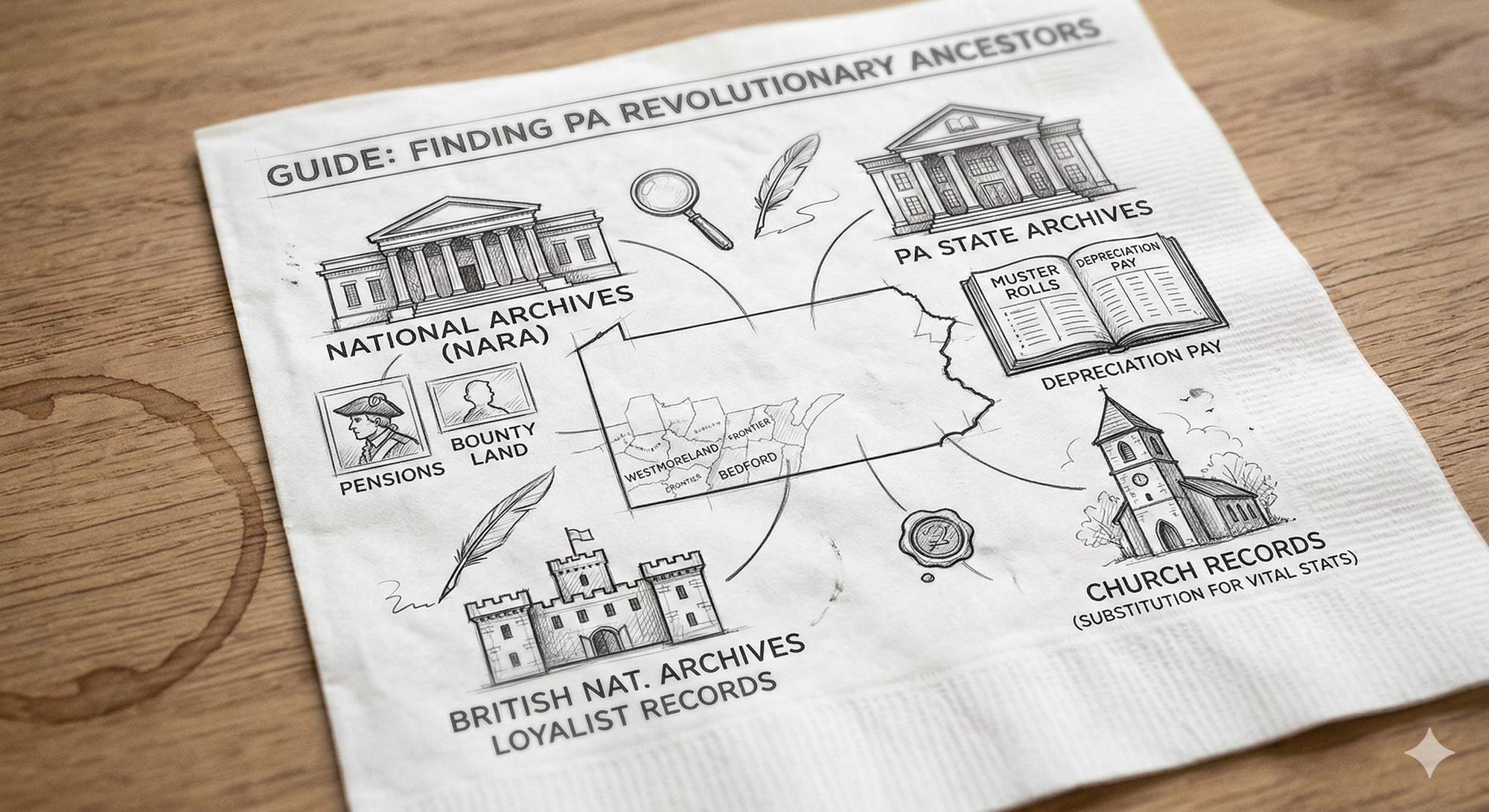
Pennsylvania Revolutionary War service records are scattered across multiple repositories — the Pennsylvania State Archives, the National Archives, and published volumes of the Pennsylvania Archives. No single source contains everything. If your ancestor served in the Revolution from Pennsylvania, you may need to check muster rolls, pay records, pension files, and bounty land applications across several collections to build a complete picture of their service.
The good news: Pennsylvania's published Pennsylvania Archives series includes extensive military records in multiple volumes, and the pension file index is free online. The challenge is knowing where to look and understanding what each record type tells you. This post walks through the major service record types and exactly where to find them.
Types of Service: Who Served and How
Pennsylvania fielded several types of military forces during the Revolution, and each generated different records.
Continental Line
Pennsylvania raised thirteen numbered regiments for the Continental Army — the Pennsylvania Line — plus artillery and cavalry units including the Light Dragoons. At peak strength this was one of the largest state contributions to Washington's army. Continental Line soldiers enlisted for specific terms (one to three years) or "for the duration." They were paid by Congress, and their records are in both federal and state collections. Continental Line service qualifies for federal pensions and for Pennsylvania's Donation Lands (land grants in western Pennsylvania reserved for Continental soldiers).
One significant event to know: the Pennsylvania Line Mutiny of 1781, when Pennsylvania troops mutinied over inadequate pay and unclear enlistment terms. Records of this mutiny may document your ancestor's presence in a Pennsylvania regiment.
The Flying Camp (1776)
The Flying Camp was a short-lived formation created in 1776 to provide rapid reinforcement where needed. It involved temporary enlistments through December 1776, and many Pennsylvania militia served in it, including at the Battle of Long Island. Flying Camp records appear in Pennsylvania Archives 2nd series, volume 14 (pages 755-777), volume 15, and 3rd series, volume 23 (pages 401-466).
Associators
Before formal military organization, Pennsylvania created the Associator system — voluntary militia companies formed from 1775. Associators elected their own officers, served short terms, and provided the first organized military response from Pennsylvania. Associator records include muster rolls, officer lists, and non-associator lists (those who refused to join). These records are published in Pennsylvania Archives, 5th series.
Militia
After the Associator period, Pennsylvania established a formal militia system requiring service from able-bodied men. Militia served short tours — often weeks or a few months at a time — and multiple tours could be aggregated. Militia records include muster rolls, pay records, and fine records for those who refused to serve. Under the 1832 pension act, militia service of six months or more (aggregated from multiple tours) qualified for a federal pension.
Navy and Privateers
Pennsylvania maintained a state navy to defend the Delaware River, including the defense of Fort Mifflin and Fort Mercer. Pennsylvania also authorized privateers through letters of marque — privately owned ships authorized to capture enemy vessels. Crew lists and prize records document privateer service. Pennsylvania Navy muster rolls appear in Pennsylvania Archives 3rd series, volume 23.
Support Roles
Not all military service involved combat. Teamsters and artificers transported supplies, built fortifications, and manufactured equipment. Express riders carried messages. Scouts and guides — especially on the frontier — provided intelligence. These support roles appear in supply records and commissary documents rather than muster rolls, making them easy to overlook but genealogically valuable.
Where to Find Service Records
Pennsylvania Archives, 5th Series (Volumes 1-8)
This is the single most important published source for Pennsylvania Revolutionary War military records. These eight volumes contain muster rolls, pay records, officer lists, and related military documents for both Continental Line and militia units. They are organized by unit and cover service from 1775 through the end of the war.
Volume 4 deserves special attention. Pages 107-496 and 599-777 contain the Depreciation Pay and Soldiers' Pay records — compensation paid to soldiers for currency depreciation during the war. These records document soldiers who definitely served but may never have received pensions. Many genealogists overlook this source completely. The pension applications list in the same volume (pages 499-596) is incomplete and does not include all names for which files exist at the National Archives. Always cross-check.
National Archives (NARA)
The National Archives holds federal military records in several key collections. Compiled Military Service Records (Record Group 93) are abstracted from muster rolls, pay records, and other documents, compiled onto individual cards for each soldier. These are available on microfilm and through Fold3. Pension files (Record Group 15) are indexed on FamilySearch and Ancestry and available in full on Fold3. Bounty land warrant applications document soldiers who applied for land grants based on service.
The key microfilm series are M881 (Compiled Military Service Records for the Revolutionary War), M804 (index to pension and bounty land warrant application files), and M805 (selected records from pension files).
Pennsylvania State Archives
The State Archives in Harrisburg holds original state-level military records including militia returns, officer commissions, and related correspondence. Many of these have been published in the Pennsylvania Archives series, but the originals sometimes contain additional detail. The Archives also holds the published volumes for on-site reference.
FamilySearch
FamilySearch provides free access to the Revolutionary War Pension Index and has microfilmed some military records from both NARA and state collections. Start here for the pension index search — it's free and covers both veteran and widow applications.
Fold3
Fold3 (subscription required, but many libraries provide access) has the most complete digital collection of Revolutionary War military records, including compiled service records and full pension files. If your library doesn't offer Fold3, check whether NARA's research rooms provide access.
Ancestry
Ancestry has some military record collections for the Revolutionary War period, including indexes and some digitized records. It's not as comprehensive as Fold3 for military records specifically, but it's worth searching if you have a subscription.
Reading Muster Rolls and Pay Records
Muster rolls list soldiers present in a unit at a specific time. They typically show the soldier's name, rank, dates of service (enlistment and discharge or present-at-muster), and sometimes notes about absence, death, desertion, or transfer. Pay records show the same names with amounts paid and dates of payment.
When reading these records, watch for name spelling variations — the clerk wrote what he heard. A soldier might appear as "Smith," "Smyth," or "Schmitt" across different rolls. Rank changes also appear: a private in one muster might be a corporal in the next. Note every detail — unit designations, officer names, and dates help you distinguish between soldiers with common names.
Don't Overlook Non-Service Records
Not finding your ancestor in military service records? That's common in Pennsylvania. Religious pacifists (Quakers, Mennonites, Amish, Moravians, German Baptist Brethren, Schwenkfelders) represented a significant portion of the population and refused military service on principle. Others were exempt due to age, disability, or essential occupations. Those who refused militia service paid fines — and those fine records are themselves useful genealogical sources.
Check non-associator lists, militia fine records in Pennsylvania Archives 3rd series volumes 5-7, and supply tax lists. Absence from military records does not mean your ancestor wasn't in Pennsylvania during the Revolution — it means you need to look in civilian records instead.
Revolutionary War Diaries in the Pennsylvania Archives
One often-missed source: personal diaries published in the Pennsylvania Archives that name individual soldiers and place them at specific locations on specific dates. These include Captain William Hendricks' diary (1775) in 2nd series, volume 15; John Joseph Henry's campaign narrative (1775-1776) in 2nd series, volume 15; Lieutenant Colonel Adam Hubley's Sullivan Expedition diary (1779) in 2nd series, volume 11; and Captain Joseph McClellan's account (1780-1782) in 2nd series, volume 11. If your ancestor served in these units or campaigns, the diary entries may provide corroborating evidence for service records — or may be the only record of their presence.
Indexes to Start With
The Pennsylvania Archives 6th series, volumes 15 (Parts 1 and 2) contain an index to muster rolls — the most comprehensive starting point for searching. Linn and Egle's Pennsylvania in the War of the Revolution, Battalions and Line in 2nd series, volumes 10-11, is another key index. The DAR and SAR databases also index patriot ancestors. Start with these before diving into individual volume searches.
Research Strategy: Step by Step
- Search the pension index on FamilySearch (free) for both the veteran's name and his widow's name
- Search Pennsylvania Archives 5th series volumes 1-8 for muster rolls and pay records — check Depreciation Pay records in volume 4 especially
- Check compiled military service records on Fold3 or at NARA (Record Group 93, microfilm M881)
- Obtain the full pension file if indexed — the index card is just the beginning; files can be hundreds of pages
- Search bounty land records — federal bounty land patents at glorecords.blm.gov, Pennsylvania Donation and Depreciation Lands at the State Archives
- Check for your ancestor's unit — once you know the unit, you can search for other soldiers who served alongside, who may appear as witnesses in pension files
- If no military records are found, search non-associator lists, militia fine records, tax records, and church records to document your ancestor's wartime presence
Pennsylvania-Specific Considerations
County matters. Pennsylvania's Revolutionary War units were often organized by county. Knowing your ancestor's county helps narrow the search to the right unit.
Name variations are common. German-speaking soldiers had names Anglicized by English-speaking clerks. Search multiple spelling variants.
The originals were destroyed. The original Revolutionary War records held by the Commonwealth were transcribed in the nineteenth century, then the originals were destroyed. The published Pennsylvania Archives is often the only surviving record. You cannot check transcriptions against originals. When citing these records, cite the Pennsylvania Archives series, volume, and page — and note that these are transcripts.
Officers were tradesmen, not gentry. Among prisoners captured at Quebec, Pennsylvania officers included a blacksmith, a hatter, a butcher, a tanner, a shoemaker, and a tavern-keeper. Do not assume that "Captain" or "Colonel" indicates a wealthy landowner. Check tradesmen records, apprenticeship records, tavern licenses, and tax records for occupational data.
Depreciation Pay records are essential. Many soldiers who served but never applied for pensions appear in the Depreciation Pay and Soldiers' Pay records in Pennsylvania Archives 5th series, volume 4. This is the most commonly overlooked military source for Pennsylvania.
For the complete guide to finding every type of Revolutionary War service record for Pennsylvania ancestors — including Continental Line, militia, Associator, naval, and bounty land records — see Pennsylvania Revolutionary Era Research by Denyse Allen.
Once you've found your ancestor's service record and know what they did during the Revolution, Chronicle Makers is where family historians turn that research into written family stories.
Frequently Asked Questions
Where are Pennsylvania Revolutionary War service records?
Service records are split between the National Archives (compiled military service records, pension files, bounty land applications) and the Pennsylvania State Archives (state-level records, published in Pennsylvania Archives 5th series volumes 1-8). The pension index is free on FamilySearch. Full pension files and compiled service records are on Fold3.
What if I can't find my ancestor in military records?
Many Pennsylvanians did not serve in the military due to religious pacifism, age, disability, or essential occupations. Check non-associator lists, militia fine records, tax records, and church records. Absence from military records is common in Pennsylvania and does not indicate Loyalism.
What is the difference between Continental Line and militia service?
Continental Line soldiers enlisted in numbered regiments for specific terms (usually one to three years) and served with the Continental Army. Militia served short tours — often weeks to a few months — closer to home. Both types of service generated records, and both qualified for pensions under the 1832 act (militia required six months total).
What are Depreciation Pay records?
Congress compensated soldiers for the loss in value of Continental currency paid during the war. These records, published in Pennsylvania Archives 5th series volume 4 (pages 107-496 and 599-777), document soldiers who were paid but may never have applied for pensions. They are the most commonly overlooked military source for Pennsylvania.
How do I know which unit my ancestor served in?
Start with the pension file (which often describes the unit) or compiled military service records at NARA. Muster rolls in Pennsylvania Archives 5th series volumes 1-8 are organized by unit. If you know your ancestor's county, search units organized from that county. Tax records and militia fine records can also indicate which militia company covered your ancestor's township.
© 2019–2026 PA Ancestors L.L.C. and Denyse Allen. All Rights Reserved.
About PA Ancestors: The authoritative resource for Pennsylvania genealogy research — vital records, county courthouses, archives, probate, land records, military records, and immigration research across all 67 Pennsylvania counties. Founded by Denyse Allen, Pennsylvania genealogy researcher and author.
More Pennsylvania Research: paancestors.com