Getting Started in Pennsylvania Genealogy Research
Following a research method and recording results helps prevent brick walls and assures that no record is missed. Here's four steps I follow for genealogy research.


For many family historians, their first hint they have Pennsylvania ancestors is a notation on the census or a death certificate of “Birthplace: Penna.”
Their next step is searching on one of the major genealogy websites for birth records. However, it soon becomes clear that research in the Keystone state is quite confounding! There are not as many birth, marriage, and death records easily found as family historians assume would be. Many of the vital records remain unindexed and therefore are not returned through search. This book will cover in its chapters exactly where to find vital records and how to search them.
But first, knowing how Pennsylvania is organized and having a approach to research in the state can help you get started, or re-started, on solid footing.
- Pennsylvania began in 1681 when William Penn received the charter for the land from England. It's first laws were issued in 1682.
- There are sixty-seven counties in the state now, including the City of Philadelphia which was founded in 1854 from the boundaries of Philadelphia County. Some today say there are 66 counties plus the City of Philadelphia. The important part to remember is that both land and counties were added from 1682 to 1878. County boundary line changes are not covered in this book. See Appendix D:Additional Resources for Research for help with county boundary changes.
- Migration was difficult in a straight east–west direction across the state due to the Appalachian Mountains. There are also only a few rivers navigable by boat, but those run north–south. People migrating from the Philadelphia area typically went south to Maryland and Virginia, then north to get to the Pittsburgh area. Keep this in mind when tracing the movements of ancestors.
- County records are essentials to vital records research and there is no central collection in the state of all county records. Pennsylvania's adjoining states of Delaware, Maryland, and New Jersey have moved most of their county records to their state archives. Pennsylvania has not done so due to the volume of county records. Many county records have been microfilmed over the years by the Utah Genealogical Association (now FamilySearch) but no county has a complete collection microfilmed and available online. Each chapter in the book provides checklists of how to search for each record type both online and offline. AI holds promise of indexing all records on microfilm in the near future, but until that happens, the research approach in this book works.
- Pennsylvania had, and continues to have, distinct regional differences: east to west, north to south, center to borders, and even county to county. Assuming people in one location kept the same records in the same way as people in another location can trip up researchers. Record-keeping practices are similar across each record type, but there are differences by location and ethnicity, particularly the farther back one goes.
- Pennsylvania ethnic diversity is astounding. AncestryDNA counts eighty distinct genetic communities across the state. To use your autosomal DNA results with your vital records research, see Chapter 2: Using DNA Results in Vital Records Research. If you have not done a DNA test through Ancestry, you do not need it. In most cases you can complete your research successfully without it.
Knowing this history and structure of Pennsylvania and its records, let's cover an approach for genealogical research that combines the power of genealogical websites and methods to analysis.
Suggested Research Approach
As was mentioned, there is little success in using the main search box on any genealogy website to find all the records you need. This approach combines what is available online with some additional analysis on the researcher's part to find what is needed. There are four steps for successful genealogical research in Pennsylvania:
- Begin at the end of a person's life and work backwards
- Create your own databases of census records
- Collect vital records on every family member
- Write about what you find as you research
Combine these four steps with the specific checklists at the end of each chapter for maximum results.
Begin at the end of a person's life and work backwards
Every biography and memoir starts with a person’s birth, moves through to the events of his or her life, and ends with his or her death.
It is tempting to research in this order of birth to death, but it can create frustration and confusion. For most of our ancestors, state law required more records be created at the time of their death than when they were born. By starting at the end of a person's life, we can gather details that will help us locate the correct birth record.
Collect every record an ancestor made where he or she died. This includes their entire estate filing (also called probate records), property (deed) records, cemetery information, obituary, and anything related to their religious practices. Most of these records are county records and were filed at the county courthouse where that ancestor lived. County newspapers are not all online, so check with the local genealogical society on where to find more newspapers. In most counties there are eight to twenty newspapers available on microfilm.
Once these records are collected combine them with the census records you have and assemble the details into a timeline of that ancestor's life. You may want to also use maps to identify exact locations and family nearby. By the end of this assembly, you should have enough information to be able to pluck your ancestor out of a group of similarly named people based on what you know. (And chances are you will encounter many similarly named people while researching in Pennsylvania!)
Create your own databases of records
When you create your own database, you can ensure that you have a thorough listing of every person with a name similar to your ancestor, and an exact location where each person lives. Plus you'll have a listing of every spelling variation of that surname.
First let's cover surname spellings, then we will create a database.
Two factors confound genealogists researching anywhere: the number of people with similar names and the number of spelling variations for surnames. In the present day, we expect people to have one, and only one, spelling of their name. But for any time prior to about 1930, the spelling of a surname could vary from slightly to significantly. Genealogy websites often assist in showing additional records with similar sounding surnames or abbreviated spellings of given names. What can be helpful is to make your own list of the various ways you've found a surname spelled or use existing resources to intentionally misspell names to ensure no name is missed. See Appendix D: Additional Resources for Research for help with name variations.
Here’s an example of the many ways a German ancestor of mine had his surname spelled on documents:
- “Streibach,” 1860 US census
- “Strwick,” 1870 US census
- “Streibig,” 1880 US census
- “Striebig,” Philadelphia Death Certificate, 1887
- “Streibig,” Union Army Pension File Index Cards
- “Streivish” and “Strinwich,” Compiled Military Service Record for Union Army
Those are the variations for one man! His siblings and parents had even more spelling variations of their shared surname. It appears that my German-speaking family didn’t spell in English for several years and simply said their name to clerks who spelled what they heard. I was only able to find Mr. Streibig in all these records because his first name was Casper, highly unusual for the time period.
Additional spellings of "Streibig" were found as I collected records on all the Streibig's who lived in the area, Most of them were related to each other, so I simply added them to my family tree. I then copied and pasted each spelling I found into the top of my research log so I had a list of what to search in each new record collection.
Why create your own database of records?
Creating your own database gives you a targeted focus for your research. In the time period prior to 1850 when only heads of households were listed on the census, having your own database allows you to methodically go through each household for your ancestor.
I frequently create databases of census records by county when I know a particular ancestor is from that county, but I don't know which household he or she is in prior to 1850. I also create databases of people with the same name across all the counties of Pennsylvania when I'm trying to target a county for research.
The two tools you need to create your own database are a spreadsheet program (Excel, Numbers, GoogleSheets) and a free account on FamilySearch.
In the example below, I'll show how I built a database of all the Heberling's in the 1830 census in Pennsylvania. I've followed Joseph in census and tax records from 1850 back to 1836 in Ferguson Township, Centre County. Joseph was born around 1814 according to records surrounding his death, so 1836 was likely the first year he was taxed (21 years of age was when taxes began). There are no other Heberling families in Ferguson, so I need to figure out if there are any Heberling households in Pennsylvania where Joseph could have come from. To ensure I examine each Heberling household, I am going to create a database of 1830 census records.
Note: FamilySearch is continually changing their website design so the images of the website shown here may not match the current website. However the steps involved of going from a broad search to a narrow one, then downloading those results, are the same.
1.On a desktop or laptop computer go to FamilySearch.com and log in. Using the main search box, type in your ancestor’s surname in the surname field, and “Pennsylvania, X” in the location field. X is the county you wish to search if you have a county. If not, just type Pennsylvania for the location. No need to enter a birth year or death year and click Search.
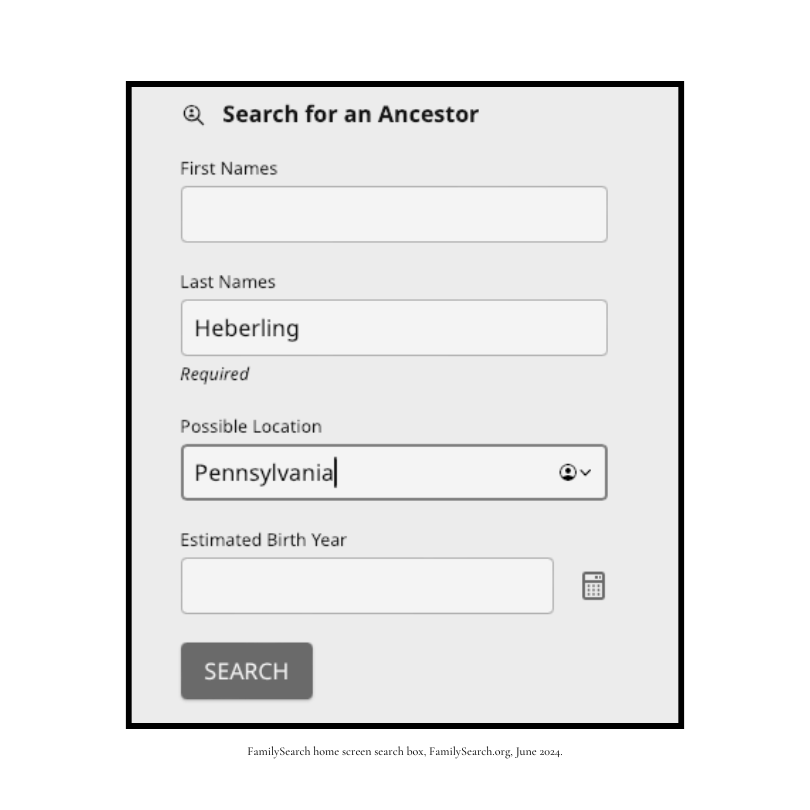
2. You will get thousands of results returned. Ignore them.
3. Look at the “Collections” in the side collection. Choose the option for censuses.
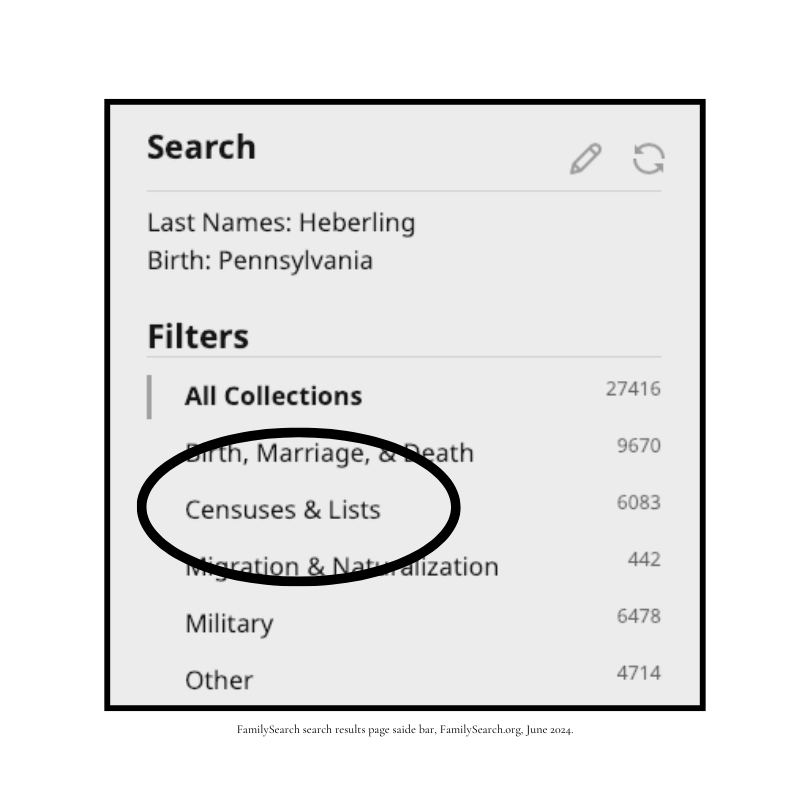
4. Scroll through the list until you see a census collection for the year you want. For my Heberling example, I am using 1830. Click on this record collection title.
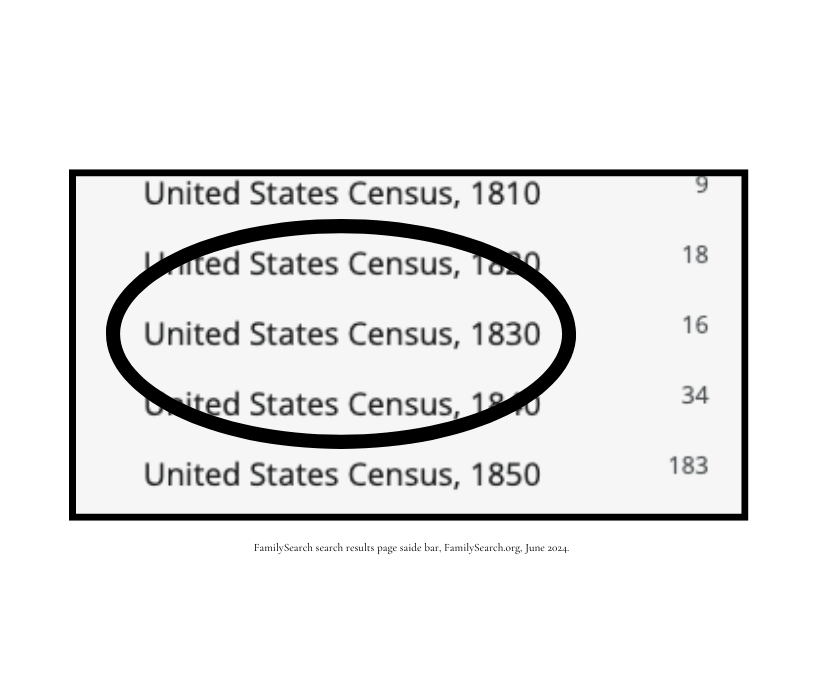
5. What you now have in the search screen is very focused list of all the heads of households with your ancestor’s surname who lived in Pennsylvania at the time of that census. In this example with Heberling's in Pennsylvania in 1830, I have 16 households. A very focused and targeted search!
Before June 2024 there was the ability to download these search results along with the attached record image as a spreadsheet file. Currently no download option exists. You can either copy and paste the information for each record into a spreadsheet with links to the image, or you can search for a data scraping app to do this for you. Data scraping is against the terms of service of most websites, so I can not advocate doing this, but it is possible.
Regardless of how you build your spreadsheet, working off a targeted list of households or individuals is superior to using the general search box. You will be able to methodically examine each household against what you know of the family and narrow your search to just those who meet your criteria. Plus by making notes of your search results along the way, your family members will be able to follow your research trail and understand how you reached the results you did.
Lastly, repeat the search and database building for each variation of the surname spelling you have. Usually genealogy websites assist in providing alternative spellings, but as I showed in the Streibig example above, some are so far off the usual spelling variations, that they get missed.
Collect vital records on every family member
Because family members are born and die in different times and places, the types of records each one creates can vary in quality. For example, Philadelphia's Department of Health began keeping death records in 1860. Those records began as listings of each individual in a ledger book. By the mid-1870s it evolved to single forms per person. The city's form evolved again to something similar to state death certificates in 1904. With each change to Philadelphia's death records, more information was collected on the deceased. Your direct line ancestor may not have the information you seek on his or her vital records, but you will find it on a sibling's record.
Each chapter in this book will tell you specifically which vital records exist by year and where to find them. If vital records do not exist for a particular time period, a list of other record suggestions is in Chapter 10: Substitutes for Vital Records.
When collecting vital records, obtain an image of the original of all vital record. Do not settle for what comes up in computer search on in an index. It really does matter for family history to have that photocopy image or digital image. Frequently genealogy websites just show parts of the birth, marriage, or death records at first. Click through to view images and download them to your computer. These original record images will have additional details such as doctors, hospitals or institutions, ministers, informants, or burial details. Through out the book when I refer to vital records, it is these original records (or their images) I am referencing.
Write about what you find as you research
Almost everyone skips this step. Most researchers stay stuck in “collecting records” thinking if they just keep searching online, everything will fall into place. What often happens is repeated searches, frustration, and mistakes.
Writing about what you find as you find it (or do not find it) prevents errors, and speeds up research. Writing encourages you to look closely at the records and put them in logical order. Once they are in order, you start noticing gaps between records or repeats in people and places. Connections and patterns previously hidden will be revealed.
Before launching into new research, take some time and make a listing of everything you have found so far. Put it all in a research log writing about the details in each document in one of the columns, or write it out in a Word document. Writing with pen and paper works too! Simple open a document image and note the details of what there. Carefully read every field, every notation, and even the back of the form, then put in on your research log or Word document.
This step feels tedious and not useful, but most researchers find they make major breakthroughs in their research when they write. Details and patterns emerge as our brain examines the facts we have found so far. We also note what is missing and discover new avenues for research.
Once you have assembled what you have and written about it, it is time to being your research in vital records.
© 2019–2026 PA Ancestors L.L.C. and Denyse Allen. All Rights Reserved.
About PA Ancestors: The authoritative resource for Pennsylvania genealogy research — vital records, county courthouses, archives, probate, land records, military records, and immigration research across all 67 Pennsylvania counties. Founded by Denyse Allen, Pennsylvania genealogy researcher and author.
More Pennsylvania Research: paancestors.com