Pennsylvania Militia and Associator Records: What Survives
Learn what's different about Pennsylvania militia records vs. Associator records and where to find each. Includes a step-by-step research strategy.

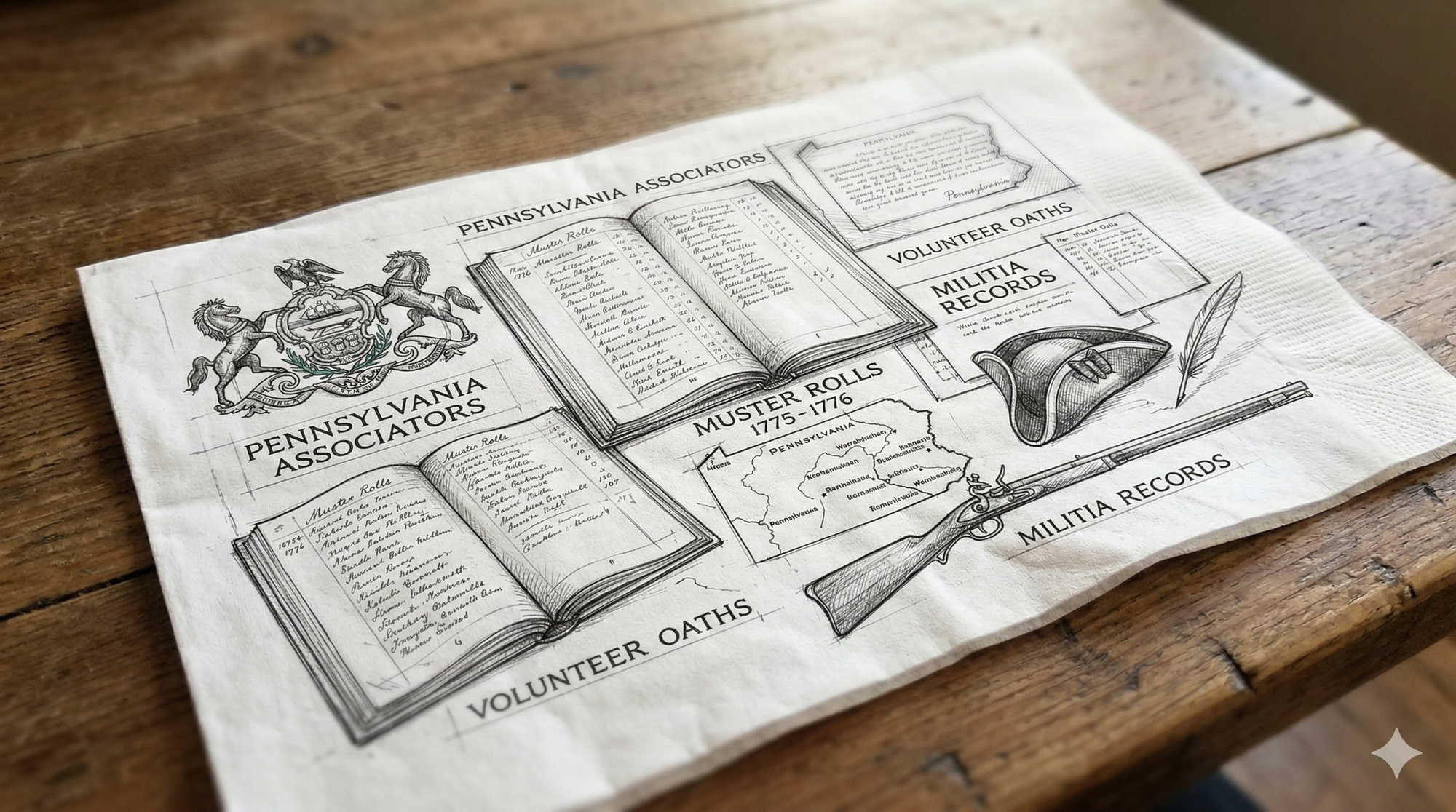
Most Pennsylvanians who served in the Revolution did not enlist in the Continental Army. They served in the militia or as Associators — the voluntary companies formed before formal military organization existed. Militia and Associator service was local, short-term, and far more common than Continental Line enlistment. If your ancestor served in the Revolution from Pennsylvania, there's a strong chance it was as a militiaman, not a Continental soldier.
The records that survive for militia and Associator service are extensive but scattered. Muster rolls, pay records, officer lists, non-associator lists, and militia fine records appear across multiple volumes of the Pennsylvania Archives and in county-level collections. Understanding the distinction between Associators and militia — and knowing where each record type lives — is the key to finding your ancestor's service.
Associators: Pennsylvania's First Military Response (1775-1777)
Before Congress established the Continental Army, Pennsylvania organized its own military response through the Associator system. In 1775, the Pennsylvania Assembly authorized voluntary military companies — the Associators — to defend the colony. Men could join voluntarily; they elected their own officers and served short terms.
Associator records are important for several reasons. They document the earliest military participation from Pennsylvania, often predating Continental Army records. They capture men who served briefly in 1775-1776 and then returned to civilian life — service that may not appear in any other military record. And the non-associator lists created alongside them document who refused to join, providing evidence of pacifism, Loyalism, or simple non-participation.
Associator records include muster rolls and officer lists published in Pennsylvania Archives, 5th series. Non-associator lists — compiled township by township — identify every man who did not associate, sometimes noting the reason (religious objection, suspected Loyalism, or no reason given). These lists are published in Pennsylvania Archives and in county records.
The Militia System (1777 Onward)
In 1777, Pennsylvania replaced the voluntary Associator system with a compulsory militia law requiring service from able-bodied men aged 18 to 53. Men were organized into companies by township and battalions by county. Service tours were typically short — weeks to a few months at a time — and men could be called up multiple times throughout the war.
This was a "come-and-go army." A single ancestor might have three or four stints under different battalion numbers or company names within a single year. Between tours, the same person appears in home-community tax records — showing the rotation pattern of militia service.
A critical research trap: battalion numbers changed during the war. After the Militia Act of March 20, 1780, the same men were listed under different battalion numbers with no notation in the published Pennsylvania Archives documenting the renumbering. The soldier didn't leave — the unit designation changed. Trace individuals across renumbered units by noting the same company composition and officer names.
The militia system generated several types of records that survive today.
Muster Rolls and Returns
Militia muster rolls list soldiers present in a unit at a given time. They appear in Pennsylvania Archives, 5th series, volumes 1-8, organized by county and unit. These rolls typically show each soldier's name, rank, dates of service, and sometimes notes about absence, transfer, desertion, or death. Muster returns — summary documents showing unit strength — also survive and provide context for individual rolls.
Pay Records
Militia pay records document compensation for service. The Depreciation Pay records in Pennsylvania Archives, 5th series, volume 4, pages 107-496 and 599-777, compensated soldiers for currency depreciation. These are crucial because they document soldiers who served but may never have received pensions. The pension applications list in the same volume (pages 499-596) is incomplete. Always check the Depreciation Pay records separately.
Militia Fine Records
Pennsylvania imposed fines on men who refused militia service. These fine records, published in Pennsylvania Archives, 3rd series, volumes 5-7, list individuals by company who were fined for "non-performance of militia duty." Fine records serve a dual purpose for genealogists: they identify Quakers, Mennonites, Moravians, and other pacifists (whose consistent willingness to pay heavy fines demonstrates religious conviction), and they may identify quiet Loyalists (those who refused service and could not or would not pay, facing property seizure).
The key distinction: conscientious objectors paid fines consistently. Loyalists often refused payment and faced property seizure.
Supply Tax Lists
Supply taxes were levied to support the war effort. These tax lists, which appear alongside militia records in the Pennsylvania Archives, show who contributed to the war financially. They capture people who may not have served in the militia but supported it through taxation — and those who refused to pay.
What Militia Records Tell You
Militia records provide different information than Continental Line records. Continental soldiers served long enlistments far from home, and their records often include detailed service narratives (especially in pension files). Militia service was local and short, so the records tend to be briefer — but they tell you things Continental records don't.
Township and county of residence. Militia companies were organized by township. Finding your ancestor in a specific militia company tells you exactly where they lived.
Community connections. The men in a militia company were neighbors. Other names on the same muster roll are people who lived near your ancestor, attended the same church, and may appear as witnesses in deeds, wills, and pension files.
Dates of presence. Muster rolls prove your ancestor was in a specific place at a specific time. If you're tracking migration, this is valuable evidence.
Service pattern. Multiple muster rolls show whether your ancestor served one tour or many — important for pension eligibility (six months total under the 1832 act) and for understanding their war experience.
Non-Associator Lists: The Record of Refusal
Non-associator lists are among the most overlooked Revolutionary War records in Pennsylvania. Compiled township by township, they identify every man who did not join the Associator companies. For genealogists, they document where an ancestor lived (the township is identified), confirm the ancestor was of military age, provide evidence of religious pacifism (many non-associators were Quakers, Mennonites, or Amish), and may indicate Loyalist sympathy (though most non-associators were pacifists, not Loyalists).
Cross-reference non-associator lists with church membership records and militia fine records to understand why your ancestor didn't serve.
Substitute Service
A man could hire a substitute to serve in his place if he could afford it. When this happened, the original man liable may appear in records indicating he paid for a substitute, and the substitute's name should also appear in service records. The connection between the two may or may not be documented — but if you find a "substitute" notation, it means someone else paid for that service.
The Originals Were Destroyed
A critical fact about Pennsylvania militia records: the original Revolutionary War records held by the Commonwealth were transcribed in the nineteenth century, then destroyed. The published Pennsylvania Archives is often the only surviving record. You cannot check transcriptions against originals. Transcription errors cannot be verified. When citing militia records, cite the Pennsylvania Archives series, volume, and page — and note that these are transcripts.
Frontier Militia: A Different War
Militia service in western Pennsylvania looked very different from service in the east. Frontier militiamen fought Indian warfare and defended settlements rather than participating in set-piece battles like Brandywine or Germantown. Their muster rolls reference specific raids, defense actions, and frontier forts rather than Continental Army campaigns.
If your ancestor served in a western Pennsylvania militia unit, their records may describe experiences unfamiliar to researchers focused on eastern service. Frontier militia records appear in the same Pennsylvania Archives volumes as eastern militia records but cover a distinctly different kind of warfare.
Pension Eligibility for Militia Service
Under the 1832 pension act, anyone who served at least six months in any military capacity — including militia — qualified for a federal pension. Service from multiple short tours could be combined to meet the six-month requirement. This is important because many Pennsylvania militiamen served several brief tours that individually seem insignificant but together met the threshold.
If your ancestor served in the militia, search the pension index on FamilySearch for both the veteran's name and his widow's name. Militia pension applications describe local operations and units that may not appear in other records, and they include the same biographical detail (age, birthplace, residence, family information) found in Continental Line pension files.
Research Strategy: Step by Step
- Determine your ancestor's county and township using tax records, church records, or census data
- Search Pennsylvania Archives 5th series for militia muster rolls from that county — volumes 1-8 cover the war period
- Check non-associator lists if your ancestor doesn't appear in militia records — these identify who didn't serve and sometimes why
- Search militia fine records in Pennsylvania Archives 3rd series, volumes 5-7 — consistent fine payment suggests religious pacifism
- Check Depreciation Pay records in Pennsylvania Archives 5th series, volume 4 — captures soldiers who served but never received pensions
- Search the pension index on FamilySearch — militia service of six months or more qualified under the 1832 act
- Obtain the full pension file through Fold3 or NARA if your ancestor is in the index
- Note every name on your ancestor's muster roll — these were neighbors who may appear as witnesses in other records
- Search supply tax lists for financial contributions to the war effort
Where to Find These Records
Pennsylvania State Archives (Harrisburg): Original militia records, published Pennsylvania Archives volumes, and county-level military records that have been transferred to the state.
Published Pennsylvania Archives: Available at major research libraries, the State Archives, and some volumes digitized online. The 5th series (military records) and 3rd series (tax and fine records) are the most important for militia research.
National Archives (NARA): Federal pension files for militia veterans who qualified under the 1832 act. Compiled military service records include some militia records.
FamilySearch: Free pension index. Some microfilmed military records.
Fold3: Full pension files and compiled service records.
County historical societies: Some hold local militia records not published in the Pennsylvania Archives.
For the complete guide to Pennsylvania militia, Associator, Continental Line, and all other Revolutionary War military records — including where each record type is held and how to interpret it — see Pennsylvania Revolutionary Era Research by Denyse Allen.
Found your ancestor on a militia muster roll? That's the beginning of a story worth writing. Chronicle Makers is where family historians turn service records and pension files into finished family chronicles.
Frequently Asked Questions
What is the difference between Associators and militia in Pennsylvania?
Associators were voluntary military companies formed in 1775 before formal military organization existed. Men could join or refuse. In 1777, Pennsylvania replaced the Associator system with compulsory militia service requiring able-bodied men aged 18 to 53 to serve. The key difference is voluntary versus compulsory — and different records survive for each.
Did Pennsylvania militiamen qualify for Revolutionary War pensions?
Yes. Under the 1832 pension act, anyone who served at least six months in any military capacity — including militia — qualified for a federal pension. Service from multiple short tours could be combined to meet the six-month requirement. Search the pension index on FamilySearch for both the veteran and his widow.
What are non-associator lists?
Non-associator lists identify men who refused to join the voluntary Associator companies in 1775-1777. They were compiled township by township and published in Pennsylvania Archives. These lists document where a man lived, confirm military age, and may indicate religious pacifism or Loyalist sympathy. Cross-reference with church records to understand why your ancestor didn't serve.
Where are Pennsylvania militia muster rolls?
Muster rolls are published in Pennsylvania Archives, 5th series, volumes 1-8, organized by county and unit. Original records are at the Pennsylvania State Archives. Some are available through Fold3 and FamilySearch.
What if my ancestor paid militia fines instead of serving?
Militia fine records in Pennsylvania Archives, 3rd series, volumes 5-7, list individuals fined for non-service. Consistent fine payment typically indicates religious pacifism (Quakers, Mennonites, Amish). These fines are themselves useful genealogical records — they prove your ancestor's residence, confirm military age, and suggest religious affiliation.
© 2019–2026 PA Ancestors L.L.C. and Denyse Allen. All Rights Reserved.
About PA Ancestors: The authoritative resource for Pennsylvania genealogy research — vital records, county courthouses, archives, probate, land records, military records, and immigration research across all 67 Pennsylvania counties. Founded by Denyse Allen, Pennsylvania genealogy researcher and author.
More Pennsylvania Research: paancestors.com